
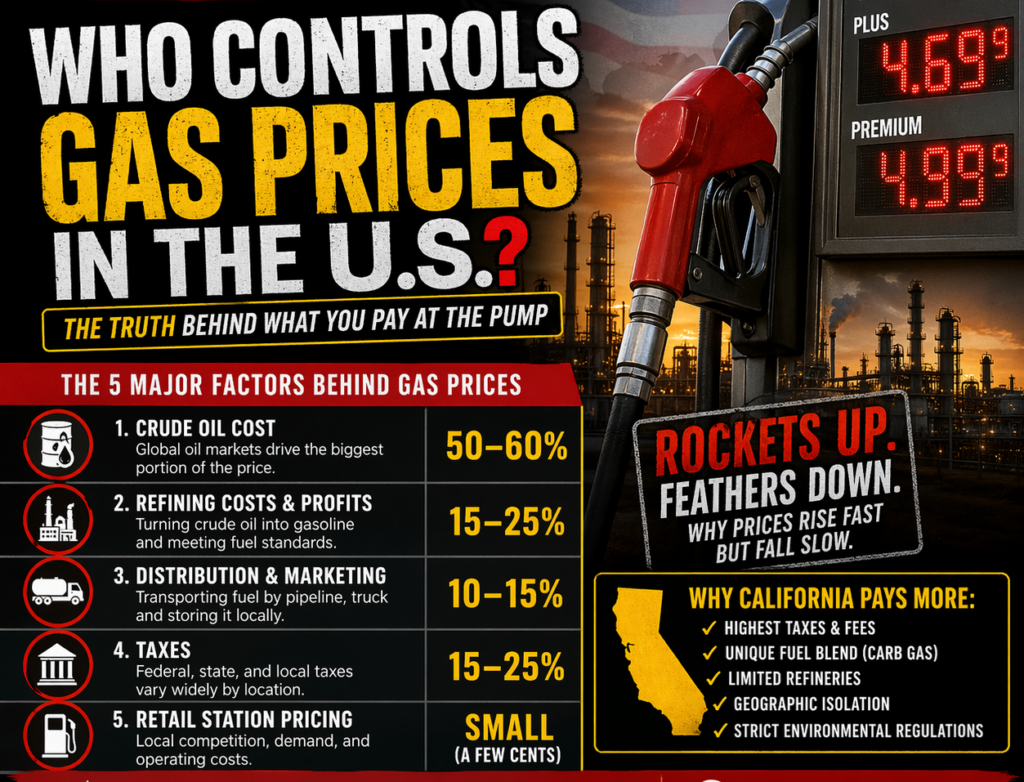
Gasoline prices at the pump are the result of several layers of costs added together along the supply chain – from crude oil production to the retail station. The price you see on the sign outside a station reflects a combination of global markets, refining costs, transportation, taxes, and the station’s own pricing strategy.
- Crude Oil Cost (Largest Component)
The biggest factor in gasoline prices is the cost of crude oil. Oil is traded globally, benchmarked by prices such as West Texas Intermediate (WTI) in the United States or Brent Crude internationally.
(WTI – is a type of light, sweet crude oil primarily sourced from the United States – Texas, Louisiana, and North Dakota. It’s characterized by its low sulfur content and low density).
(Brent Crude refers to a trading classification of sweet light crude oil from the North Sea – this grade is described as light because of its relatively low density and low sulfur content.)
Crude oil typically accounts for about 50-60% of the retail gasoline price. When global oil prices rise – due to supply disruptions, geopolitical tensions, or production cuts – gas prices usually rise as well.
- Refining Costs
Crude oil must be processed into gasoline at refineries. Refining adds costs for:
- Operating refineries.
- Converting crude oil into gasoline and other products.
- Meeting environmental fuel standards.
In the U.S., refining and profits from refineries usually account for about 15-25% of the pump price.
- Distribution and Marketing
Gasoline must be transported from refineries to storage terminals and then to local gas stations. This involves:
- Pipelines.
- Tanker trucks.
- Storage facilities.
- Wholesale distribution companies.
These costs typically represent about 10-15% of the final price.
- Taxes
Taxes vary significantly depending on location. Drivers in California, for example, generally pay higher gasoline taxes than most other states. Gasoline taxes include:
- Federal tax (set by the United States federal government) – currently 18.4 cents per gallon.
- State tax.
- Sometimes local taxes or environmental fees.
Taxes often make up 15-25% of the pump price, depending on the state.
Highest Gas Taxes
- California: 70.9 cents per gallon.
- Illinois: 66.4 cents per gallon.
- Washington: 59.0 cents per gallon.
Lowest Gas Taxes
- Alaska: 8.95 cents per gallon.
- Hawaii: 18.5 cents per gallon.
- New Mexico: 18.9 cents per gallon.
The average gas tax across the nation is approximately 29.15 cents per gallon, with 23 states above this average and 27 below it.
- Retail Gas Station Pricing
Individual gas stations set their own prices. Owners consider:
- The wholesale price they pay for gasoline.
- Prices charged by nearby competitors.
- Local demand.
- Their operating costs (rent, wages, electricity, credit-card fees).
Stations usually make very small margins on fuel, often only a few cents per gallon, and rely more on convenience store sales for profit.
- Local Competition and Demand
Gas stations frequently adjust prices based on:
- Competitor prices across the street.
- Traffic patterns.
- Time of day or week.
- Tourism or seasonal demand.
This is why two stations a block apart can have noticeably different prices.
___
Why Prices Change Quickly
Gas stations often raise prices quickly when wholesale costs increase but lower them more slowly. This pattern is sometimes called “rockets and feathers” pricing behavior in energy economics.
___
CALIFORNIA
Gasoline prices in California are typically well above the U.S. national average because of a combination of taxes, environmental regulations, fuel supply constraints, and market structure. It is a cumulative effect of several unique conditions in the state.
- Higher State Taxes and Fees – California has some of the highest gasoline taxes in the United States. Major components include:
- Federal tax: $18.4 cents per gallon. – same for all states.
- California state excise tax: $.60 cents per gallon. – the highest in the United States – the average across all states is $.28/gal.
- State and local sales taxes: $.10 cents per gallon.
- Environmental and regulatory fees: $ .54 cents per gallon.
- Underground storage tank fee: $.02 cents per gallon
Altogether, taxes and regulatory fees in California can add as much as $1.26 per gallon.
- Special California Gasoline Blend – California requires a unique cleaner-burning fuel called CARB gasoline. This formula reduces smog and air pollution but is more expensive to produce:
- Only a limited number of refineries can make it.
- Gasoline from other states cannot easily be substituted.
- Supply disruptions can cause sharp price spikes.
These regulations come from air-quality laws originally strengthened after the federal Clean Air Act requirements and California’s stricter state standards.
- Limited Refinery Supply
California has relatively few refineries serving a very large market. Important refineries include facilities owned by companies such as:
- Chevron
- Marathon Petroleum
- Valero Energy
Because the state is isolated from other U.S. fuel markets:
- Gasoline cannot easily flow in through pipelines from other regions.
- If a refinery shuts down for maintenance or an outage, prices can jump at the pump quickly.
- Geographic Isolation of the Fuel Market
Most U.S. gasoline moves through large pipeline networks between regions. California’s fuel market is largely separate from the rest of the country. Instead, fuel must arrive by:
- Tanker ship.
- Local refining.
- California also imports gasoline from other countries, including India and South Korea.
This makes it slower and more expensive to increase supply when shortages occur.
- Environmental Programs
California operates several climate policies that affect fuel costs, including cap-and-trade program administered by the California Air Resources Board. Fuel suppliers must purchase emissions allowances, and those costs are typically passed on to the consumers at the pump.
___
Unfortunately, California has very limited ability to significantly reduce gasoline prices for consumers while maintaining its current tax structure and regulatory framework. The state’s gasoline policy intentionally places a heavy financial burden on petroleum fuels to fund infrastructure and encourage a transition away from gasoline. Because of that design, lowering consumer prices would require reversing several major policy pillars.
What Would Actually Be Required to Lower Prices? – meaningful price reductions would require major policy reversals such as:
- Reducing the state excise tax.
- Suspending cap-and-trade costs on fuel.
- Relaxing fuel blend requirements.
- Approving new refinery capacity.
Each of these actions would face strong political and environmental opposition because they conflict with California’s Democratic Party climate goals.
In summary: California’s gasoline prices are high largely by political policy design. Taxes, environmental fuel standards, carbon programs, and limited refining capacity all raise costs. Unless the state changes those policies – which currently support transportation funding and climate objectives – there is very little room for significant price reductions for the residents of California.
James Peifer