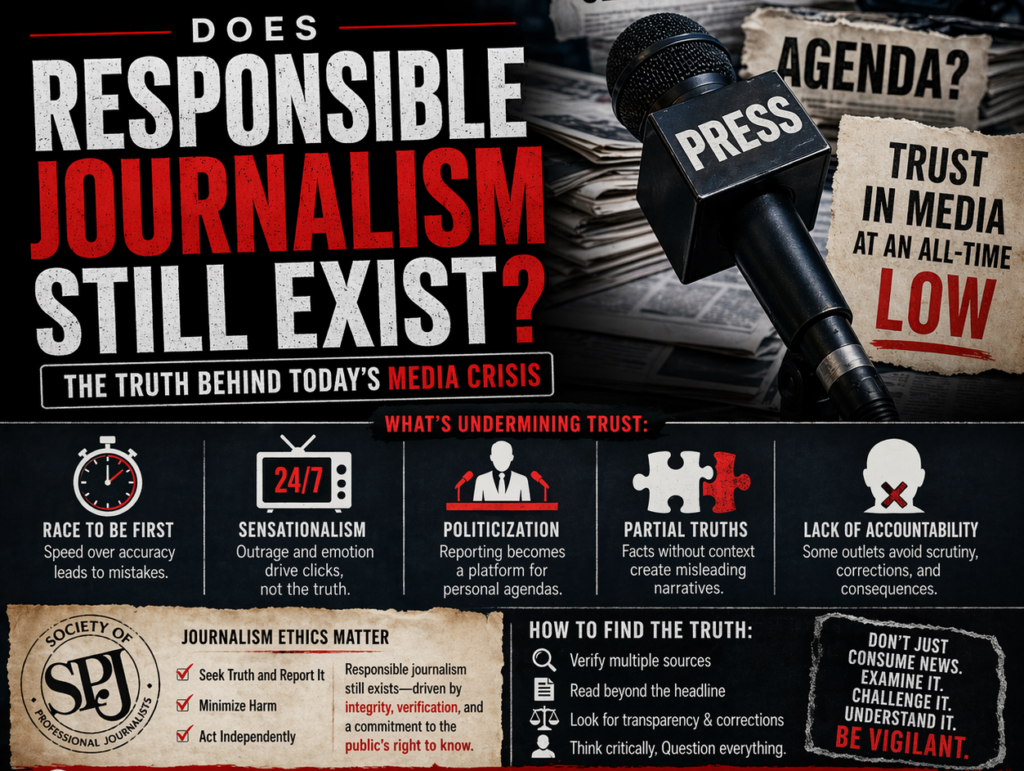
Trust in the American media is at an all-time low. Recent surveys indicate that only 28% of Americans express a “great deal” or “fair amount” of trust in newspapers, television, and radio. This decline in trust has been observed across various demographics and political affiliations, with both national and local news organizations experiencing decreased confidence.
The erosion of trust in media has been a growing concern for decades. Surveys show that while Americans generally trust local news more than national outlets, overall confidence in media has significantly declined.
Responsible journalism still exists in America, but like most institutions, it is uneven and often contested.
The Society of Professional Journalists (SPJ) publishes a lofty Mission: The mission is to improve and protect journalism by promoting high ethical standards, fostering excellence, and defending First Amendment rights. SPJ advocates for free-flowing information, supports journalists through training and legal defense, and encourages diversity, aiming for a well-informed citizenry.
SPJ encourages journalists to adhere to a code of ethics. Key principles of Journalism Ethics include:
- Seek Truth and Report It: Journalists must be honest and verify information from all sources.
- Minimize Harm: Ethical journalists treat all individuals with respect and compassion.
- Act Independently: Journalists should avoid conflicts of interest and prioritize the public’s right to know.
There are still newsrooms and reporters today that:
- Rely on multiple verified sources.
- Issue corrections transparently.
- Separate news reporting from opinion.
- Publish primary documents.
- Submit – to editorial standards and fact-checking processes.
Responsible journalism has always existed alongside irresponsible journalism. The difference today is that journalism is competing with far more noise:
- Information volume is exponentially larger.
- Distribution is instantaneous.
- Anyone can publish.
- Algorithms amplify emotional content.
Some critics argue that parts of American journalism have drifted away from traditional ethical standards. This is not a uniform failure across the profession, but rather a pattern that shows up in certain outlets, moments, or individuals.
When journalists fall short, the criticisms tend to cluster around a few recurring behaviors.
One is the politicization of reporting. Instead of acting as independent observers, some journalists are seen as framing stories in ways that align with a preferred political narrative. This does not always mean fabricating the facts – more often, it shows up in story selection, emphasis, and tone. It depends on what gets covered, what gets ignored, and how events are contextualized. Over time, news audiences may begin to feel they are being guided toward conclusions rather than presented with a balanced account.
Another issue is the erosion of accuracy. In 24/7 media environment, being first can take priority over being fully correct. Initial reports may rely on incomplete information, and while corrections might come later, they rarely receive the same visibility as the original claims. This can leave lasting impressions that are not fully aligned with the verified facts.
Sensationalism is a frequent concern. Headlines and framing may amplify the most emotionally charged aspects of a story – conflict, outrage, scandal – because those elements drive clicks and engagement. The result can be a distorted sense of scale or importance, where rare or ambiguous events are presented as widespread or definitive.
A more subtle but equally consequential problem is the use of partial truths. A report may include elements but omit key context that would materially change how the news audience interprets those facts. By selectively presenting information – quotes without full context, statistics without comparison, or allegations without proportional scrutiny – coverage can create a misleading narrative without stating anything explicitly false.
There is also the question of harm to individuals. Ethical journalism calls for minimizing unnecessary harm, particularly when reporting on private citizens or unverified accusations. When stories are published prematurely or without sufficient corroboration, reputational damage can occur even if later reporting complicates or contradicts the original claims. In the digital age, those initial narratives can persist indefinitely.
It is important to recognize that many journalists and outlets actively try to uphold rigorous standards, often under difficult conditions – financial pressure, consolidation of newspaper ownership, shrinking newsrooms, and intense public scrutiny. Failure of journalists to uphold ethical standards in reporting contributes to growing polarization among audiences.
___
The following are well-documented cases where major United States media outlets were accused of ethical failures:
The New York Times – Jayson Blair scandal (2003)
Reporter Jayson Blair was found to have fabricated and plagiarized dozens of stories, sometimes reporting from places he never visited.
He invented details, sources and entire scenes. His editors missed repeated warning signs. His false reporting damaged credibility across multiple stories.
Management was forced to address the ethical issues raised by the scandal – the breakdown of fact-checking systems – institutional pressure and favoritism – the publication of false information presented as fact.
The New York Times published a lengthy public correction calling it a “profound betrayal of trust.” Top editors at the newspaper resigned. Internal reforms were introduced such as stronger oversight and the creation of a public editor role.
___
The Rolling Stone – University of Virginia “A Rape on Campus” (2014)
The magazine published a dramatic account of a gang rape at the University of Virginia that later collapsed under scrutiny and was fully retracted.
The story relied on a single source – key witnesses were not contacted – and contradictory evidence was ignored.
The magazine was forced to address the ethical issues raised by false reporting – sensationalism, reporting an emotionally powerful narrative prioritized over verification – partial truth, failure to include perspectives that would challenge the story – and harm to individuals, falsely accused fraternity members and administrators faced with damage to their reputations.
Investigators concluded the story showed a failure of basic reporting and fact checking.”
___
NBC NEWS – BRIAN WILLIAMS CONTROVERSY (2015)
Brian Williams, one of the nation’s top-rated news anchors, lied about his copter being shot and forced down in Iraq.
He falsely reported that, “We were in some helicopters. What we didn’t know was that we were north of the invasion. We were the northernmost Americans in Iraq. Two of the four helicopters were hit, by ground fire, including the one I was in, RPG and AK-47.”
But Williams’ account was contradicted by crew members of the 159th Aviation Regiment on board a Chinook copter that was hit by two rockets and small arms fire. They told Stars & Stripes that Williams was nowhere near that helicopter and two other Chinooks in the formation of fire.
NBC News management were forced to address the ethical issues raised by Williams false reporting. His blurring of the facts and personal storytelling – damage to credibility in broadcast journalism – and questions about accountability for high-profile figures.
Brian Williams was suspended from NBC News and removed from his highly prized, anchor role.
A PATTERN ACROSS MULTIPLE SCANDALS (THE Washington Post, The New Republic, and more)
The Columbia Journalism Review and others often group several cases together.
- Janet Cooke (fabricated story at the Washington Post).
- Stephen Glass (fabrications at The New Republic).
- Jayson Blair (New York Times).
These cases share a pattern – competitive pressure for standout stories – weak editorial safeguards – and stories that were too compelling to be questioned rigorously.
Sum and Substance
Across these examples, a few consistent themes emerge.
- Failure to verify (Rolling Stone).
- Fabrication or exaggeration (Brian Williams, Jayson Blair).
- Narrative-driven reporting without overriding skepticism.
- Institutional breakdowns, not just individual mistakes.
Every citizen has a right to be skeptical. Modern news is often filtered through editorial priorities, audience expectations, and political leanings. Even highly opinionated outlets still do real reporting. For example, a straight news article in The New York Times or Wall Street Journal will typically be more fact-driven than their opinion sections. The same applies to cable outlets like Fox News or CNN – their daytime reporting often differs significantly from prime-time commentary.
Read laterally across ideological lines. If a story matters, compare how it is covered by outlets perceived to be left-leaning, center, and right-leaning.
- Left-leaning: MS NOW, The Guardian, Washington Post
- Center-ish: Reuters, Associated Press
- Right-leaning: New York Post, Washington Examiner
The differences you will notice are often in framing, emphasis, and what gets omitted.
Yes, responsible journalism does exist. It’s not easy to find. You must search for it.
As President Reagan once said years ago regarding the Russians – Trust but verify!
James Peifer