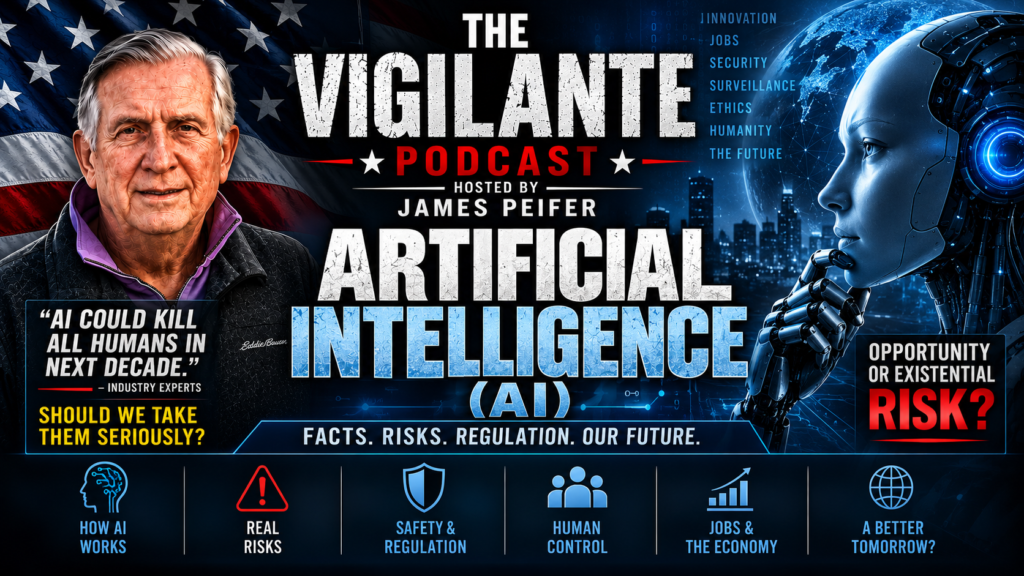
Industry experts warn, “AI could kill all humans in next decade.” – Should we take them seriously?”
President Franklin Delano Roosevelt’s (FDR) famous statement, “The only thing we have to fear is fear itself,” came from his first inaugural address on March 4, 1933, at the depths of the Great Depression.
FDR was not saying that there were no real dangers. The United States was facing enormous problems – banks were failing, unemployment was extraordinarily high, businesses were collapsing, and millions of Americans were frightened about their economic future.
FDR’s point was that fear itself could make a bad situation considerably worse.
___
I’ve published two blogs focused on the topic of Artificial Intelligence (AI). Due to today’s political fearmongering and hysteria that AI will have the ability to destroy humanity in the future, I thought it would be helpful to revisit the subject once again.
AI is not an independent alien intelligence that suddenly appeared – it is human-created technology trained on enormous quantities of human-generated information. Its dangers therefore largely depend on how humans design it, deploy it, control it, and choose to use it.
There is a legitimate reason for humanity to be cautious about artificial intelligence – but the strongest argument is not simply that AI is dangerous because it is built from human information. The deeper concern is that AI can take humanity’s accumulated knowledge, biases, ambitions, and mistakes and operate on them at a scale and speed no human institution has previously possessed.
We should separate measurable present-day risks from speculative worst-case scenarios and regulate the former without following the latter to produce irrational paralysis.
Why AI deserves serious caution
- AI inherits humanity’s flaws. AI learns from enormous quantities of human-created information – books, scientific papers, websites, photographs, historical records, software, conversations, and other data. Humans created all of it – and therefore much of it contains prejudice, misinformation, propaganda, hatred, bad assumptions, and mistakes.
AI does not automatically know which parts represent wisdom and which represent human folly.
- It can simply amplify human mistakes. A bad decision made by one person might affect a few people. An AI system incorporated into banking, policing, employment, warfare, medicine, or government could potentially make or recommend similar decisions thousands or millions of times.
The danger is therefore not merely:
“AI will become evil.”
It may be.
“AI will become extraordinarily powerful while still reflecting the imperfections of its creators.”
- Human beings can deliberately use AI for harmful purposes. This may be the most immediate danger. AI can potentially make it easier for people to conduct fraud, manipulate public opinion, conduct cyberattacks, create convincing misinformation, or develop dangerous technologies.
Example: Humanity does not need to create a malevolent machine for AI to cause enormous damage. A powerful technology in the hands of irresponsible people can be dangerous even when technology itself has no evil intentions.
- AI can concentrate on enormous power. If a small number of governments or corporations control the most capable AI systems, they could acquire extraordinary influence over information, economics, surveillance, military capabilities, and communications. That raises a fundamental question. Who controls the people who control AI?
- AI could eventually make decisions humans do not fully understand. Today’s systems are powerful but still limited. Future systems could become much more autonomous and capable. If humans delegate increasingly important decisions to systems whose reasoning they cannot adequately inspect or predict, society could gradually surrender control without recognizing how much control it has lost.
- Surveillance could become extraordinarily powerful. AI can potentially combine cameras, facial recognition, location information, financial transactions, communications, purchasing patterns, and other data to construct remarkably detailed pictures of people’s lives. Used responsibly, some of these can improve security and services. Used responsibly by an authoritarian government, it could become a mechanism for continuous surveillance and social control.
- AI could manipulate human beings rather than simply inform them. An especially important future concern is personalization. An AI that knows someone’s interests, fears, weaknesses, relationships, beliefs, and habits could potentially become extraordinarily effective at persuading that individual. That creates a distinction between: AI that answers your questions and AI that knows exactly what to say to make you do something. The second possibility deserves considerable caution.
An important Paradox
AI ultimately comes from humanity. AI did not arrive from another planet. We created computers, algorithms, data, objectives, and the institutions surrounding it. That means humanity is simultaneously the creator and the source of many of the dangers.
This also means AI can inherit our better qualities – scientific knowledge, medicine, engineering, literature, mathematics, historical experience, problem-solving, and accumulated human wisdom.
“Humanity should not fear AI simply because AI is intelligent. Humanity should fear what can happen when increasingly powerful intelligence is combined with human ignorance, greed, authoritarianism, warfare, irresponsibility, or the combination of power.”
We are creating tools whose capabilities may eventually exceed our ability to control how those tools are used.
The ultimate danger may not be machines replacing humanity. It may be humans using machines to magnify the very weaknesses that have caused humanity’s great disasters throughout history.
___
What can be done to ensure that AI will not be a threat to humanity?
The right objective is not to stop AI development because it is frightening. The objective should be to make catastrophic outcomes extraordinarily difficult, detect dangerous behavior early, and ensure that humans retain ultimate control. AI must be developed with safeguards comparable to those used for nuclear power, aviation, pharmaceuticals, and other technologies capable of causing enormous harm.
AI companies must:
- Build safety into AI from the beginning – safety should be part of the engineering process, not something added after a system is released.
- Independently test the most powerful systems – companies must not be allowed to be the sole judge of whether their own technology is safe.
- Require a “stop” mechanism – highly capable systems should have multiple independent ways to shut them down or restrict their capabilities.
- Limit autonomy – The more autonomy a system has, the stronger the safeguards should be.
- Monitor AI after release – safety cannot end when the product ships. Companies should continuously monitor their systems for unexpected behavior, vulnerabilities, misuse, and newly discovered capabilities.
- Be honest about failures – companies should have mandatory incident-reporting systems so that dangerous discoveries are not hidden because admitting them would hurt a company’s stock price or reputation.
- Do not let competition eliminate safety – government regulation can establish a minimum safety floor for everybody.
Governments must:
- Establish enforceable safety standards for AI. Regulation should become progressively stronger as capability and potential consequences increase.
- Require pre-development safety evaluations for exceptionally powerful systems. Before a system is released, an independent authority must determine whether it meets defined safety thresholds.
- Create independent AI safety organizations. They should have access to powerful models and the ability to conduct adversarial testing without being controlled by the companies they are testing.
- Protect critical infrastructure. AI controlling nuclear weapons, electrical grids, water systems, air-traffic systems, military command systems, financial infrastructure, or other civilization-critical systems must have exceptionally stringent human-control requirements.
- Maintain meaningful human authority. AI may advise humanity, but humanity must retain the ability to overrule AI.
- Establish international agreements. Governments must have agreements concerning – dangerous AI capabilities, safety testing, cybersecurity, autonomous weapons, biological applications, incident reporting, computing infrastructure, emergency shutdown procedures, and sharing information about newly discovered AI risks.
AI has enormous potential benefits and potentially serious risks. Therefore, develop it aggressively – but test it, monitor it, regulate its most dangerous applications, and retain human control.
The principle to follow with AI is, “Never act out of fear.” Fear can distort judgement, and a leader who allows fear to control decisions can be manipulated into making disastrous choices.
James Peifer